ART & THOUGHT · STUDIO NOTE · 2026
The gradual formation of a visual language through a work in progress
Marie Dernoncourt · TousCréateurs
This reflection is also available in French. Read the French version.
My work does not begin with a theory of the cube. It has taken shape slowly, through trials, applications, overpainting, subtraction and periods of observation. Certain forms returned. So did certain tensions. Gradually, a language began to reveal itself in the relationships between matter, the void, cubes, lines and light.
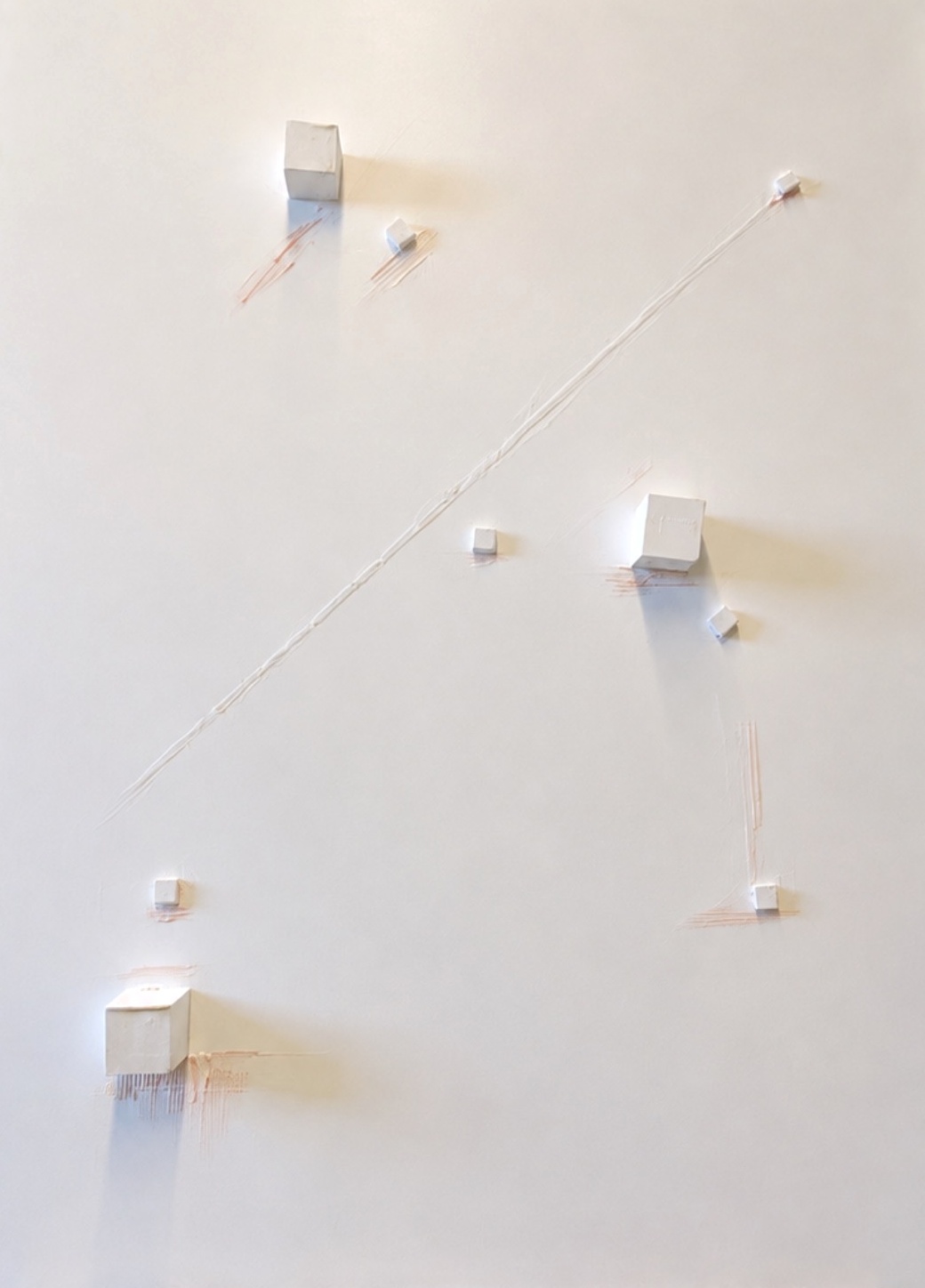
The canvas shown here is unfinished. I have nevertheless chosen to present it because it makes visible a decisive moment in the process: repetition establishes a habit, then a line and several shifts disturb the rule. The work offers no answer. It opens a possibility.
A language does not always precede the work
At first, I was searching less for a signature than for an abstraction that would be neither decorative nor illustrative. I wanted to understand how a surface could hold together through its own relationships: density against the void, relief against a trace, a line that brings together or separates. Reading and the history of abstraction nourished this enquiry, but they could not produce the language in my place. It had to emerge through the actual work.
Experiments came before the current works. Some sketches have disappeared; some canvases were reworked or painted over. This incomplete history still matters: it shows that the vocabulary was not invented afterwards to construct an artist’s discourse. It formed through continuity, resistance and selection.
Containing the flow without becoming chaotic
I begin with a very concrete sense of the contemporary world: too much information, too many images, too much speed, too many demands competing for our attention. But I am not trying to paint this chaos. I try instead to receive it, then let it settle.
The world produces noise. Matter receives it. Subtraction seeks the place where presence can finally appear.
The overall movement might be expressed like this: noise, matter, subtraction, threshold, silence, breath. This is not a programme that every canvas must obey. It is a mechanism observed after the fact, stable enough to illuminate what recurs in my work without confining it.
Removing to breathe
Subtraction began as a technical gesture. I applied, drew, shifted, then took away whatever made the surface too talkative. Over time, this gesture became a principle of construction. To remove is not to impoverish. It is to take away what prevents the rest from existing with precision.
The question is therefore no longer only what I can still add. It becomes: what can disappear without presence disappearing with it? This question asks me to resist the seductive gesture, spectacular materiality, or colour added simply to fill the space.
Removing to breathe does not mean removing until nothing remains. It means removing until what remains finally begins to act.
The void becomes active
White is no longer a neutral ground. It separates, connects, slows and gives measure to distance. It allows a faint shadow, an almost erased trace or a small volume to become perceptible. The void therefore takes part in the construction just as fully as matter.
I am not seeking a clinical void. I am seeking breathing space, able to hold without overwhelming the eye. The less immediate information the surface gives, the more the eye must remain, shift its position slightly and allow relationships to appear. The painting does not seize attention abruptly; it tries to alter its rhythm.
The cube is not a logo
The cube has become recurrent, but its presence alone does not make an artwork. If it were only a recognisable sign, it would quickly become a formula. What matters is what it does in space: depending on its scale, position, relationship to other elements and the light it receives, it can weigh, hold back, stabilise, interrupt, mark a threshold, detach itself or almost disappear.
I therefore reject a fixed dictionary in which the cube would always mean the individual, the line always the path and the void always freedom. Meaning arises from the relationships between elements. The same cube can change function from one canvas to another, and even within a single composition.
Repetition establishes a habit
To repeat a form is to put it to the test. What does it become when it holds, when it contains, when it is isolated, crossed, almost absorbed by the white or separated from a group? Repetition is fruitful only when it produces differences and new relationships.
The work in progress adds a more precise dimension: repetition can create a perceptual habit. Several groupings pair a larger volume with a smaller element. The configurations vary, but their structure returns. The eye gradually learns a rule. It anticipates a relationship before it has even put it into words.
The line acts as a force
Not all lines perform the same function. Some bring two areas closer. Some create a local tension. Others interrupt an organisation or open a passage. They are not merely graphic: they alter the balance of forces across the surface.
Here, the small pinkish traces remain connected to the volumes and form local directions. The long white diagonal acts differently. It crosses almost the entire field, has a momentum of its own and leads the eye towards a tiny cube near the upper-right boundary. It does not mechanically connect every cube; it introduces an autonomous force into an already organised territory.
A work in progress put to the test
This work allows me to test the coherence of the language without imposing a story on the painting. We can observe different masses, groupings, intervals, a large diagonal and areas of silence. The larger cubes give weight. The smaller ones act almost like particles. Real shadows shift the values of white and make light active.
At first, repetition establishes a familiar organisation. Then a more isolated element begins to move away from it. Finally, the long line leads to the small cube near the edge. In visual terms, we can say that it has detached itself from the repetitive system and is approaching a boundary. We cannot say that it is free.
This distinction is essential. The cube still remains within the canvas and is still attached to the trajectory. The line that seems to offer it a way out might equally be another form of constraint. The work therefore suspends meaning rather than resolving it.
A way through guarantees nothing
The word resolution closes things too quickly. It suggests that a problem has reached its end. Escape route can imply avoidance. A way through remains more open: it contains movement, a possible breakthrough and a prospect of elsewhere, without promising what lies beyond the boundary.
Repetition → constraint → shift → way through → ?
The final sign belongs to the viewer. The small cube may seem to be attempting an exit, shifting, fleeing, beginning something else or meeting a new constraint. The canvas does not decide. It shows less the achievement of freedom than the possibility of a shift.
Allowing the viewer in
I do not want to tell the viewer what they must understand. If I write that the final cube has freed itself, I close the work and decide in their place. If I preserve the uncertainty, they can encounter their own question before the canvas: this is where I am. What now?
The work then ceases to be an answer I address to the viewer. It becomes a space in which they can recognise a tension without my imposing its outcome. This openness is not deliberate vagueness intended to allow anything. It rests on precise visual facts: repetition, distances, masses, direction, edge and suspension.
Painting and music share a breath
In music, silence is not an absence. It gives duration to what precedes it and prepares what may follow. In painting, the void acts in a comparable way. A form can enter like a note, a line can draw the space taut, repetition can establish a rhythm, then a shift can alter the way the eye listens.
Perhaps this is why my stopping point feels similar in both practices. When the elements begin to produce too much noise or to explain what does not need explaining, I remove. I seek a balance in which the eye can rest without the work becoming inert.
What remains begins to act
Today, I can recognise a simple architecture behind different works. The world produces flow. Matter receives it. Gesture organises. Subtraction lets it settle. The cube contains or displaces. The line creates tension or opens a passage. The void creates distance. Light reveals. Repetition establishes a structure. A shift can disturb it. And meaning remains unfinished.
This architecture is not a definitive manifesto. It must not become a cage for future works. It is a faithful snapshot of where my enquiry has led me: to construct relationships between matter, the void, tension, repetition and shift so that the gaze may slow down, and something may remain unresolved.
I am not trying to fill the silence. I am looking for the place where it becomes presence.
MARIE DERNONCOURT · SEPTEMBER 2026
This reflection is also available in French. Read the French version.
Text, artwork and photography © 2026 Marie Dernoncourt, touscreateurs.eu. All rights reserved. Copyright and terms of use.